After the Water
Slavery ended, and the faith the African Muslims carried lived on mostly as memory. In the twentieth century Islam came back to Black America by several roads, not all of them leading to the same place. One ends at a masjid in Fayetteville that carries Omar ibn Said’s name.
What was remembered
In the Library of Congress, in the same collection as Omar ibn Said’s autobiography of 1831, there is a booklet printed in 1927 for the Moorish Science Temple of America. Beside it are two issues of Jet magazine from 1975: one mourning Elijah Muhammad, leader of the Nation of Islam, and one on the son who took his place.12 They belong to the same story. This chapter follows it.
Slavery ended in 1865. Of the faith the African Muslims had carried, what reached the next generations was mostly memory. On Sapelo Island in the 1930s, old people remembered grandparents who knelt on a mat to pray at sunrise, noon and sunset, and who made rice cakes called saraka for the children.3 How much more survived, nobody can say. Scholars have asked whether a folk memory of Islam lived on among the children and grandchildren of the enslaved, and have called the question unanswerable.4
In the early 1900s, some Muslim leaders in America began to say that Islam was the natural religion of Black people, drawing on the stories of the Africans who had been carried off centuries before.5 Clara Muhammad, who would build the Nation of Islam with her husband, remembered how she first heard it, from a friend:6
My girlfriend told me there's a man who's saying some things about our people. We once dressed in long flowing cloth and we were royal. We were not Christians. We were Muslims.
The roads back to Islam were several, and they did not all lead to the same place.
A shaykh from Dongola
Among the Sunni teachers at work in America in those years was an African. Satti Majid was born in 1883 in Old Dongola, on the Nile in what is now Sudan, into a well-known holy family, and he memorized the Quran as a boy. He seems to have reached the United States in 1904, at the age of twenty-one.4
He lived in New York and later in Buffalo, and he founded one Muslim society after another. In 1921 he was writing to the British consul in New York on behalf of sailors from Aden and India who were stranded in the city without work. In 1928 he founded the African Muslim Welfare Society in Pittsburgh. His African American followers wrote to him from Pittsburgh and Detroit.4
Late in the 1920s someone brought him a book that called itself The Holy Koran, put out by an African American preacher. Satti read it and found in it no verse of the Quran and no saying of the Prophet. By his own account he wrote to its author and told him to change his name and burn his book. On January 31, 1929, he sailed from New York for Egypt, and he put the question to the scholars of al-Azhar, who answered with a fatwa condemning the book’s author.4
He never came back. His American followers kept writing to him for years, and sending money. He went home to Sudan sometime in the 1940s and died there in 1963.4
Other missionaries came from further east. Mufti Muhammad Sadiq, from the Punjab, was the chief missionary in America of the Ahmadiyya, a movement from South Asia, from 1921 to 1923. By the middle of 1922 he had moved its headquarters from Highland Park, Michigan, to Bronzeville on the South Side of Chicago. He taught his followers to read the Quran and to study Arabic, and large numbers of Black American women joined him.7 Sunni Muslims do not accept the movement’s claims for its founder, Mirza Ghulam Ahmad, who in 1888 declared himself the Mahdi and the Promised Messiah. In Sunni belief no prophet can come after Muhammad, peace be upon him, whom the Quran calls the seal of the prophets.78
The Moors
The preacher whose book Satti Majid read was Noble Drew Ali. He was born Timothy Drew in North Carolina in 1886, a child of formerly enslaved parents, and little else about his early life is certain. He opened his first temple in Newark, New Jersey, in 1913. In the 1920s he moved to Chicago, which became the center of his movement, the Moorish Science Temple of America.4
He proclaimed a new revelation out of Morocco, the land of the Moors, and his followers called themselves Moorish Americans.41 In 1927 he gave them a book of his own, The Holy Koran of the Moorish Science Temple of America.1 It was not the Quran, and it did not pretend to be a copy of it. One scholar traced more than half of it to an American mystical book, The Aquarian Gospel of Jesus the Christ. Drew Ali died in 1929.4
The scholars who published Satti Majid’s papers were fair to both men. To Satti, a man who wrote his own scripture and claimed a prophet’s place had put himself outside Islam, and he answered as a Sunni scholar should. He could hardly have been expected, they wrote, to see why Black Americans, a generation out of slavery, needed a new account of who they were.4
The Nation
In 1930 a peddler of silks named Wallace Fard began preaching a new faith in Paradise Valley, the Black neighborhood of Detroit. Almost everything dependable that is known about him falls between 1930 and 1934. He founded the Temple of Islam and a school he called the University of Islam, which despite its name taught mainly children and teenagers.59
Elijah Poole, who had worked as a sharecropper in Georgia, had come north to Detroit with his wife Clara by 1923 and worked in the car industry until the Depression put him out of work.10 By Jamillah Karim’s account, it was Clara who brought him Fard’s teaching, in 1930.6 He joined in 1931, took the name Elijah Muhammad, and was made chief minister that same year. When Fard disappeared in 1934, Elijah Muhammad took his place, and by the Second World War he had built the movement into a network of mosques across the country.910
The Nation taught that white people were devils, created to oppress the Black race, that Fard was divine, and that Elijah Muhammad was his Messenger.101112 Those teachings set it apart from Islam as Muslims everywhere else understood it. In the Quran, God is One, and there is none comparable to Him, and Muhammad, peace be upon him, is the seal of the prophets.138
It also gave its members much that they valued. Jamillah Karim, a scholar of Islam in America, has said that it taught her parents to love their African features, and gave them a school for their children.6 Its most famous convert found it in a prison cell.
Malcolm’s pilgrimage
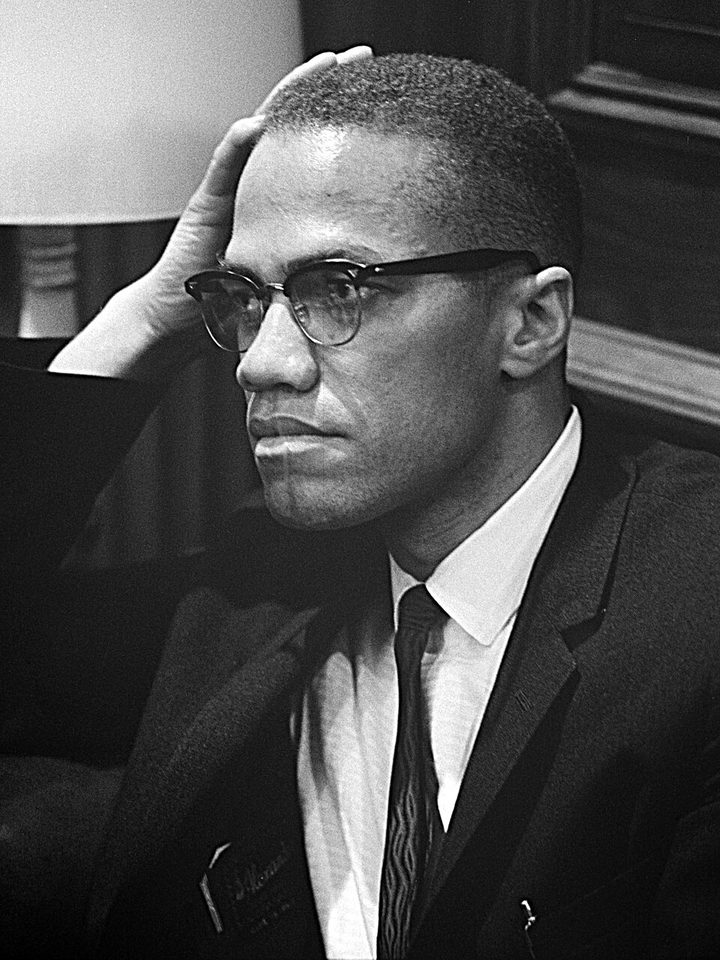
Malcolm Little was born in Omaha, Nebraska, in 1925, the son of a Baptist preacher who followed Marcus Garvey. He was in prison in Massachusetts when his brother Reginald drew him to Elijah Muhammad’s teaching. Paroled in 1952, he became Minister Malcolm X. The X stood in place of the African name that had been taken from his enslaved ancestors.14
He became the Nation’s most effective minister. By 1954 he led its temple in New York, and from 1957 he was its national representative, second in influence only to Elijah Muhammad. In 1964 he counseled a young boxer who announced, soon after winning the heavyweight title, that he had joined the Nation and taken the name Muhammad Ali.14
In March 1964 Malcolm broke with the Nation. In April he made the pilgrimage to Makkah, and the sight of Muslims of every color worshiping together, he reported, made him give up the belief that all white people were devils. He turned to Islam as it was practiced outside the Nation.1412 The Quran speaks to that sight in a verse addressed to all people:15
O people, We have created you from a male and a female and made you into nations and tribes so that you may recognize one another. Indeed, the most noble of you before Allah is the most righteous among you. Indeed, Allah is All-Knowing, All-Aware.
From Makkah he traveled to Egypt, Lebanon, Nigeria, Ghana, Senegal and Morocco, and he met Ghana’s president, Kwame Nkrumah. He came home in May with a new name, el-Hajj Malik el-Shabazz.14 Omar ibn Said had been taken from Futa Toro, in what is now Senegal, in 1807.16 A hundred and fifty-seven years later, a Black American Muslim went there by choice.
He was shot and killed on February 21, 1965, as he began a speech at the Audubon Ballroom in New York. The Autobiography of Malcolm X, written with Alex Haley, came out later that year.14
Bilal’s name
Elijah Muhammad died in Chicago on February 25, 1975. Jet gave him its cover, “Nation mourns Muslim leader,” and inside, “Muhammad leaves great legacy of pride and respect.”210 His son Wallace took his place. Born in 1933 and named for Fard, he had learned to read Arabic as a boy. After 1961, in prison for refusing the draft, he read the Quran for himself and began to question his father’s teaching. His father put him out of the Nation three times, and each time they were reconciled.11
He moved quickly to turn the whole community toward Sunni Islam. Ministers became imams. Members were taught the five pillars, the prayer as Muslims everywhere pray it, and the fast of Ramadan. He set aside the teaching that Fard was divine and disbanded the Nation’s paramilitary wing.1117 By August, Jet‘s cover read “New Muslim leader charts interracial future of his nation.”2 In time he changed his own name, to Warith Deen Mohammed.11
He renamed the newspaper too. Muhammad Speaks became Bilalian News, after Bilal ibn Rabah, the son of an Abyssinian mother whose voice was the first to call the adhan. On October 24, 1975, the new title appeared faintly behind the old one on the masthead, above a front page that read “MASTER BILAL.”17 The story this reading room begins with, of Africa inside the first Muslim community, had come to the South Side of Chicago.
The schools of the University of Islam were renamed for his mother, as the Sister Clara Muhammad Schools, and became the largest network of Islamic schools in the United States.6 In 1976 a Senegalese scholar, Shaykh Hassan Cisse, made his first journey to America, and he and Imam Mohammed came to respect and support each other’s work. In the 1980s Shaykh Hassan opened a Quran school in Senegal for Black American children, the African American Islamic Institute, where hundreds of them studied beside students from across Africa.6
Not everyone followed. Another member of the Nation, Louis Farrakhan, revived it under its old name and with its old teachings.11 In 1992 Imam Mohammed became the first Muslim to deliver an invocation in the United States Senate, and he prayed at both of President Clinton’s inaugural prayer services.1118 He told PBS in 2003:
We should realize that the first identity is not an African or a European or a Saudi. The first identity is a human being.
He died in September 2008, a month after his last public appearance.11
New neighbors
In 1965, the year Malcolm was killed, a new immigration law overhauled a quota system that had for decades kept out most people from outside Western Europe.19 In the years that followed, Muslims came from South Asia, from Africa and beyond.
A Pew Research Center survey in 2017 found that Black Americans were about a fifth of the country’s Muslims, and that about half of Black Muslims were converts. Most said they were Sunni, or Muslim with no particular label; two in every hundred identified with the Nation of Islam. Seven in ten had been born in the United States, and many of the rest came from Africa south of the Sahara, from countries such as Somalia and Ethiopia.5
Ethiopia is where this reading room begins: the kingdom of the Negus, who gave the first Muslims refuge about 615.
Back on Murchison Road
In Fayetteville, North Carolina, a mosque established in 1987 was renamed in 1991 for Omar ibn Said, the scholar who had been jailed in that town and wrote on the walls of his cell in Arabic. In 2001 it served about a hundred families.20 It describes itself as an Islamic community in association with the leadership of Imam W. Deen Mohammed.21
It is Masjid Omar Ibn Sayyid, at 2700 Murchison Road. In 2010 the state set its historical marker for Omar at the edge of the masjid’s front lawn.1622 The masjid’s imam, Bobby Thomas, told a Fayetteville magazine in 2024 that he and other local Muslims believe Omar never embraced Christian beliefs.16 The Library of Congress calls him a convert.23 Across the Water leaves the question open, and so does this chapter.
Omar ibn Said died, still enslaved, probably in 1863. About a hundred and twenty-eight years later, Muslims in the town where he had been jailed gave his name to their house of prayer. Every Friday at 1:15 in the afternoon they gather there for the Friday prayer.21 To visit, see the Carolina trail.
Sources
- Library of Congress, Omar Ibn Said Collection: The Holy Koran of the Moorish Science Temple of America (1927) and Koran Questions for Moorish Americans (1928). loc.gov
- Library of Congress, Omar Ibn Said Collection: Jet magazine of March 13, 1975 (“Nation mourns Muslim leader Elijah Muhammad”) and August 14, 1975 (“New Muslim leader charts interracial future of his nation”). loc.gov
- Georgia Writers’ Project, Drums and Shadows: Survival Studies among the Georgia Coastal Negroes (University of Georgia Press, 1940).
- Ahmed I. Abu Shouk, J. O. Hunwick and R. S. O’Fahey, “A Sudanese Missionary to the United States: Satti Majid, ‘Shaykh al-Islam in North America’, and his Encounter with Noble Drew Ali, Prophet of the Moorish Science Temple Movement,” Sudanic Africa 8 (1997), pages 137 to 191. Archived copy. web.archive.org
- Besheer Mohamed and Jeff Diamant, “Black Muslims account for a fifth of all U.S. Muslims, and about half are converts to Islam,” Pew Research Center, January 17, 2019. pewresearch.org
- Sapelo Square, “Islamic Education: Reclaiming Our West African Islamic Legacy,” January 31, 2018, on a talk by Jamillah Karim. sapelosquare.com
- Sylvia Chan-Malik, “Profile: Black American Women in the Ahmadiyya Movement of Islam,” Sapelo Square, February 24, 2016. sapelosquare.com
- The Quran 33:40, in the English of the Rowwad Translation Center, QuranEnc. quranenc.com
- R. Gallaher, “Wallace Fard,” BlackPast.org, June 11, 2008. blackpast.org
- National Archives, African American Heritage, “Elijah Muhammad.” archives.gov
- PBS, God in America, “People and Ideas: W. Deen Mohammed,” October 11, 2010. pbs.org
- Martin Luther King, Jr. Research and Education Institute, Stanford University, “Malcolm X.” kinginstitute.stanford.edu
- The Quran, chapter 112, in the English of the Rowwad Translation Center, QuranEnc. quranenc.com
- Clayborne Carson, “Malcolm X,” American National Biography (Oxford University Press), in the copy kept at Stanford University. web.stanford.edu
- The Quran 49:13, in the English of the Rowwad Translation Center, QuranEnc. quranenc.com
- Teri Saylor, “Living in Islamic faith: ‘It’s principled and timeless’,” CityView (Fayetteville), February 27, 2024. cityviewnc.com
- Ellen McLarney, “Bilalian News,” Duke Islamic Studies Center, February 8, 2026. islamicstudies.duke.edu
- Congressional Record, September 15, 2008, “In Memorial of W.D. Mohammed,” remarks of Representative Keith Ellison. congress.gov
- History, Art and Archives, United States House of Representatives, “Immigration and Nationality Act of 1965.” history.house.gov
- Fayetteville Area Convention and Visitors Bureau, Heritage Trails: Religious Freedom Trail (2018). assets.simpleviewinc.com
- Masjid Omar Ibn Sayyid, Fayetteville, home page. masjidomaribnsayyid.org
- North Carolina Department of Natural and Cultural Resources, Highway Historical Marker I-89, “Omar ibn Said.” dncr.nc.gov
- Library of Congress, Omar Ibn Said Collection, with the collection essay. loc.gov
Teaching this chapter? Print the study pack: a leader’s page, a handout with readings and questions, and the answers.