Houses of Learning
A mosque is built. A teacher sits by a pillar. Students gather, and in a few generations there is a school. Africa has some of the oldest that are still open.
Kairouan, 670
In 670, the fiftieth year after the Hijrah, Uqba ibn Nafi laid out a camp town in what is now Tunisia and marked the place for its mosque. Almost nothing of his building survives. The Great Mosque of Kairouan that stands today was largely rebuilt in the ninth century, and its minaret, dated to 836, is among the oldest still standing anywhere.1
Kairouan became the great school of Maliki law in the west. One of its jurists, Ibn Abi Zayd al-Qayrawani, who died in 996, wrote a short handbook called the Risala. Children across West Africa memorized it for the next thousand years. Keep that book in mind. It turns up again in chapter four, written out from memory on an island off Georgia.
Fez, 859
According to tradition, a woman named Fatima al-Fihri, whose family had come to Fez from Kairouan, spent her inheritance founding a mosque in 859. It took its name from her people: al-Qarawiyyin, the mosque of the Kairouanis.
UNESCO and Guinness World Records describe al-Qarawiyyin as the oldest existing, continually operating educational institution in the world.2 Two cautions belong beside that sentence. Historians point out that the story of Fatima comes from a chronicle written centuries later, and that an inscription found in the mosque credits a different founder. And for most of its life al-Qarawiyyin was a mosque where scholars taught, in the old way, not a university in the modern sense. It became a state university in 1963. Neither caution makes the place younger. People have been studying in that courtyard for more than eleven hundred years.
Cairo, 972
The Fatimids founded al-Azhar in 970 and held the first Friday prayer there in 972. Lessons are recorded from 975, and in 988 it was organized as a place of teaching with paid scholars.3 It has been teaching, with interruptions, ever since. In Tunis the Zaytuna mosque is older still by tradition, dated to 698 and rebuilt about 732.
Timbuktu
Timbuktu has three old mosques: Djinguereber, Sankore and Sidi Yahia. Tradition dates Djinguereber to 1327, after Mansa Musa came home from the pilgrimage. UNESCO placed the town on the World Heritage List in 1988.4
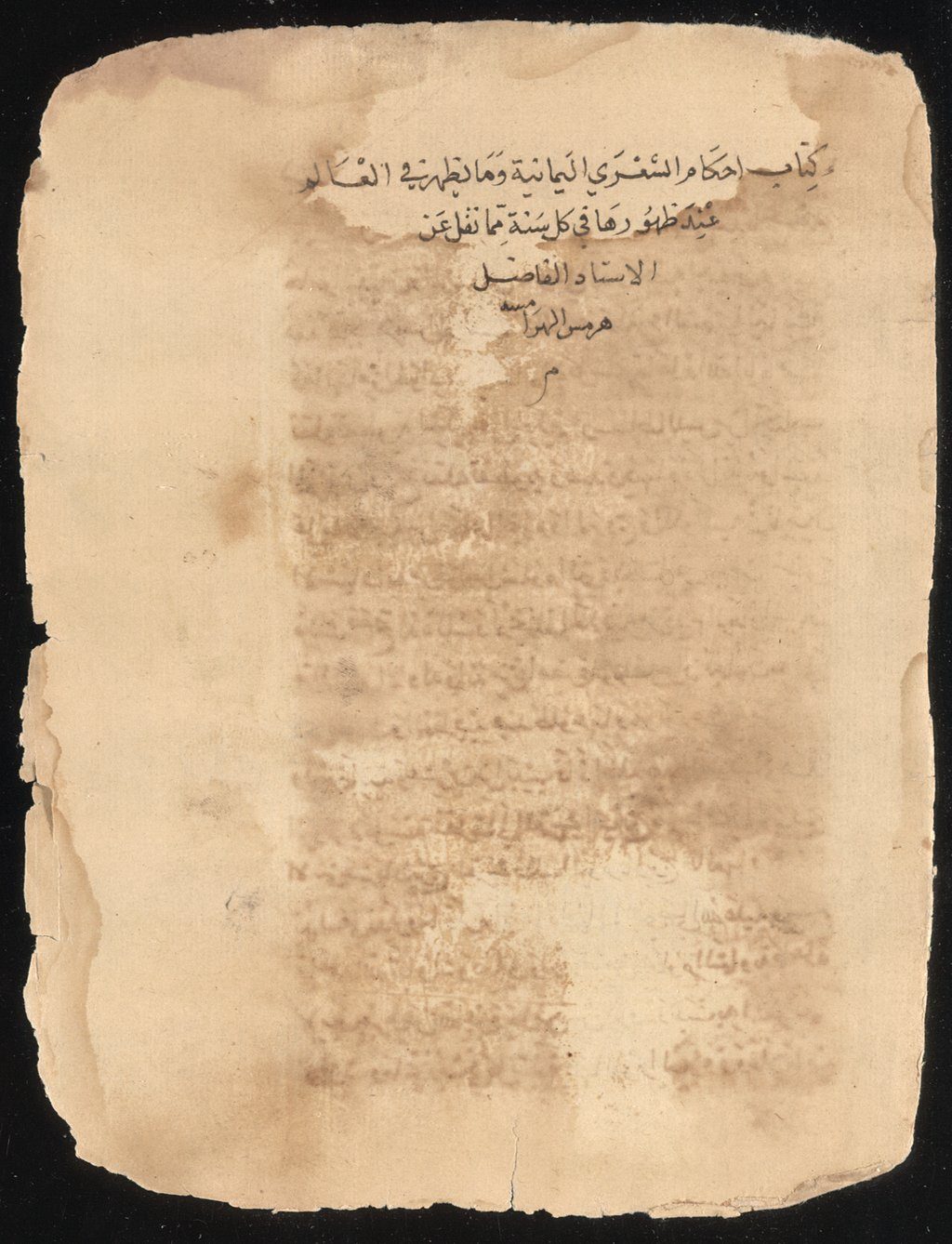
What made Timbuktu was not the buildings. Scholars taught in their own houses and kept their own libraries, and books were the luxury trade. Leo Africanus, who visited about 1510, wrote that more profit was made there from selling manuscripts than from any other merchandise.
Ahmad Baba, born in 1556, was the town’s most famous scholar. After the Moroccan conquest of 1591 he was deported to Marrakesh in chains, taught there for years, and came home in 1608. He is reported to have told his captors that his library of some 1,600 volumes was the smallest among his family’s.5
The libraries are still family property. In 2012 and 2013, when armed groups held the town, the librarian Abdel Kader Haidara and his colleagues packed hundreds of thousands of manuscripts into metal trunks and moved them south to Bamako, by car, by cart and by river.
Chinguetti, Harar, Sokoto
In the Mauritanian desert, the old caravan towns of Ouadane, Chinguetti, Tichitt and Oualata, founded in the eleventh and twelfth centuries, are listed together by UNESCO.6 Chinguetti’s families still keep manuscript libraries in mud-brick houses.
In eastern Ethiopia, the walled town of Harar holds 82 mosques, three of them from the tenth century, and 102 shrines. UNESCO notes that it is considered the fourth holiest city of Islam.7
And in Sokoto, in what is now northern Nigeria, Nana Asma’u, who lived from 1793 to 1864, wrote poetry and teaching verse in Arabic, Fulfulde and Hausa. About 1830 she organized something new: a body of women teachers, called jajis, who traveled between villages to teach other women, the students known as the yan-taru. Her verse was the curriculum, composed to be memorized.8
The lawh
Most of this learning began the same way, and in many places it still does. A child is given a لَوْح, a lawh: a smooth wooden board with a handle. The teacher writes a few verses on it in ink made from soot and gum. The child recites until the verses are known by heart. Then the board is washed clean and the next verses are written.
Lamine Kebe, a teacher from Futa Jallon who spent about thirty years enslaved in the American South, described these schools to an American who wrote his account down.10 This site takes the shape of that board as its mark. The man who keeps it is a student, and so is everyone in these pages.
Sources
- UNESCO World Heritage Centre, Kairouan. whc.unesco.org
- UNESCO World Heritage Centre, Medina of Fez. whc.unesco.org
- UNESCO World Heritage Centre, Historic Cairo. whc.unesco.org
- UNESCO World Heritage Centre, Timbuktu. whc.unesco.org
- Ousmane Oumar Kane, Beyond Timbuktu: An Intellectual History of Muslim West Africa (Harvard University Press, 2016).
- UNESCO World Heritage Centre, Ancient Ksour of Ouadane, Chinguetti, Tichitt and Oualata. whc.unesco.org
- UNESCO World Heritage Centre, Harar Jugol, the Fortified Historic Town. whc.unesco.org
- Beverly B. Mack and Jean Boyd, One Woman’s Jihad: Nana Asma’u, Scholar and Scribe (Indiana University Press, 2000).
- Nehemia Levtzion and Randall L. Pouwels, editors, The History of Islam in Africa (Ohio University Press, 2000).
- Allan D. Austin, African Muslims in Antebellum America: Transatlantic Stories and Spiritual Struggles (Routledge, 1997).