Kingdoms and Roads
Islam traveled Africa by caravan and by monsoon. It moved with merchants and teachers more often than with armies, and kings took it up at their own pace.
The Sahel
South of the Sahara lies the Sahel, the shore of the desert, where caravans from the north met gold from the south. Islam arrived with the traders. In 1068 the geographer al-Bakri described the capital of Ghana as two towns, one of them Muslim, with twelve mosques, salaried imams and muezzins, and jurists and scholars.1
Rulers followed in their own time. The kings of Kanem, by Lake Chad, are traditionally said to have accepted Islam about 1085.
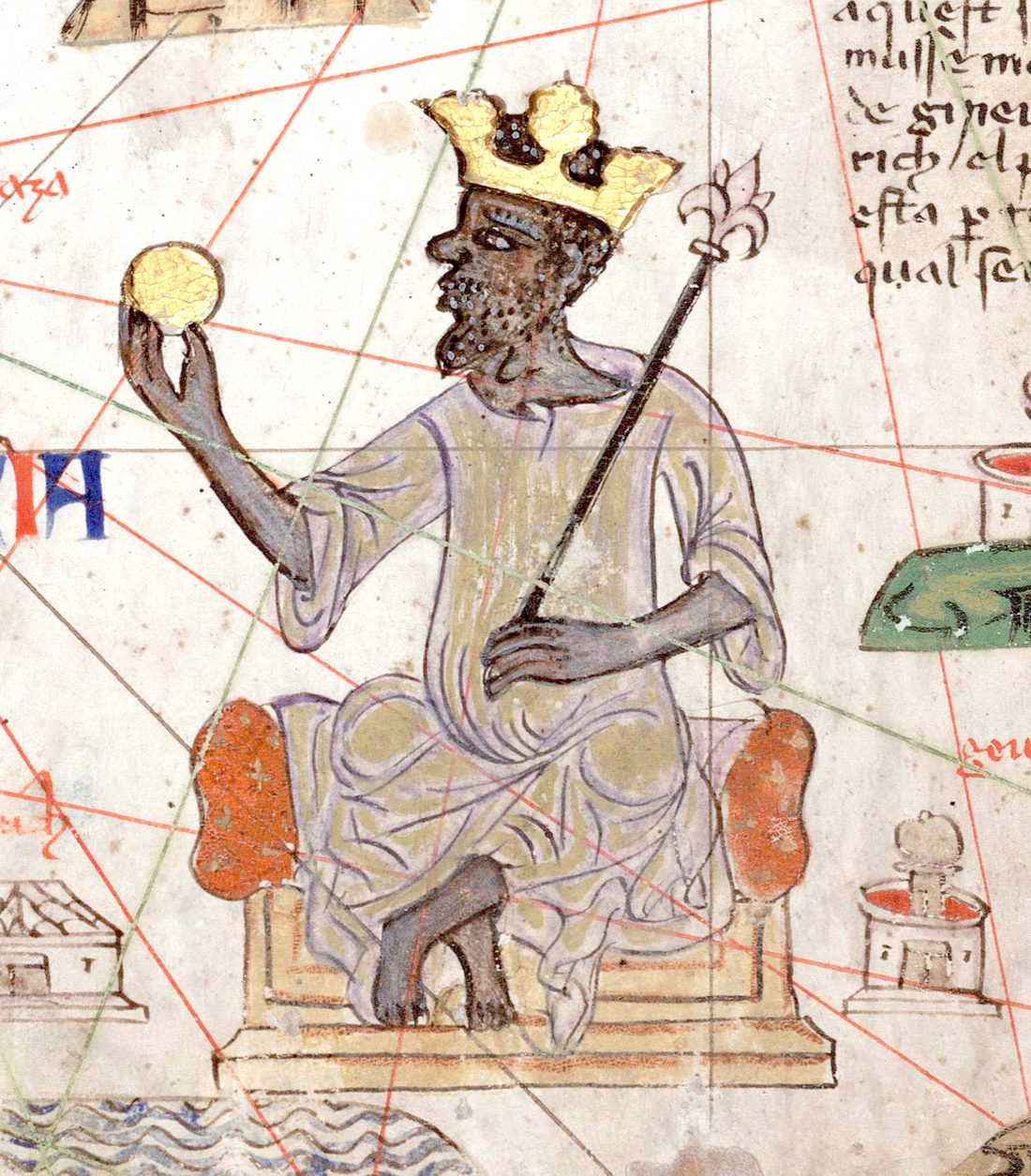
Mansa Musa, 1324
Mansa Musa ruled Mali from about 1312 to about 1337. In 1324 he set out for Makkah, and the road took him through Cairo. He gave away so much gold there that the historian al-Umari, who came to the city about twelve years later, found people still talking about it, and reported that the metal had lost value in the market and had not yet recovered.1
He came home with scholars and books. Tradition credits him with the great mosque of Djinguereber in Timbuktu. In 1375 a mapmaker’s workshop on Majorca drew him on the Catalan Atlas, seated and crowned, holding out a disk of gold. It may be the most famous picture of an African king made in the Middle Ages.2
Songhay
Mali’s place was taken by Songhay. Askia Muhammad, who ruled from 1493 until his son deposed him in 1528, made the pilgrimage in 1496 and 1497 and filled his court with scholars. Timbuktu’s great century was his. It ended in 1591, when an army from Morocco crossed the desert with firearms.
The man from Tangier
Ibn Battuta was born in Tangier in 1304. At twenty-one he left for the pilgrimage, and by his own account he kept traveling for about twenty-nine years and some 75,000 miles.3
Africa frames his book. About 1330 he sailed down the east coast to Mogadishu, Mombasa and Kilwa, which he called one of the most beautiful and well-built towns in the world. In 1352 he crossed the Sahara to Mali. He admired how safe the roads were, how seriously people took the Friday prayer, and how hard children were made to work at memorizing the Quran. He also complained about a good deal. His Rihla was dictated to a scribe named Ibn Juzayy and finished in 1355.
The monsoon coast
On the Indian Ocean, the winds reverse twice a year, and a ship could sail from Arabia to Africa and home again inside twelve months. Islam came down that coast early. At Shanga, in the Lamu archipelago of Kenya, the archaeologist Mark Horton excavated a sequence of mosques, one under another, and dated the earliest to the late eighth century.4
At Kizimkazi on Zanzibar, a mosque carries an inscription dated 500 after the Hijrah, which is 1107. It is the earliest dated inscription on the East African coast.5 At Kilwa, in Tanzania, the Great Mosque was begun in the eleventh or twelfth century and enlarged in the thirteenth and fourteenth. Its ruins have been on the World Heritage List since 1981.6 The language of that coast, Swahili, takes its name from the Arabic word for shores.
Sokoto, 1804
In 1804 a scholar and preacher named Usman dan Fodio, born in 1754, launched a reform movement in Hausaland that became the Sokoto Caliphate, one of the largest states in Africa in its century. Its founders were writers before they were rulers. Dan Fodio, his brother Abdullahi and his son Muhammad Bello left hundreds of works between them, and his daughter Nana Asma’u taught the women.
A treaty across the ocean
One more road leads west. In December 1777 the sultan of Morocco, Muhammad III, opened his ports to ships of the new United States, which made Morocco the first country to recognize it. The treaty of peace and friendship the two signed in 1786 is described by the State Department as the longest unbroken treaty relationship in American history.8
By then the other crossing had been running for more than two centuries. That is the next chapter.
Sources
- Nehemia Levtzion and J. F. P. Hopkins, editors, Corpus of Early Arabic Sources for West African History (Cambridge University Press, 1981).
- Michael A. Gomez, African Dominion: A New History of Empire in Early and Medieval West Africa (Princeton University Press, 2018).
- Ross E. Dunn, The Adventures of Ibn Battuta: A Muslim Traveler of the Fourteenth Century (University of California Press, revised 2012).
- Mark Horton, Shanga: The Archaeology of a Muslim Trading Community on the Coast of East Africa (British Institute in Eastern Africa, 1996).
- S. Flury, “The Kufic Inscriptions of Kisimkazi Mosque, Zanzibar, 500 H. (A.D. 1107),” Journal of the Royal Asiatic Society (1922).
- UNESCO World Heritage Centre, Ruins of Kilwa Kisiwani and Ruins of Songo Mnara. whc.unesco.org
- Nehemia Levtzion and Randall L. Pouwels, editors, The History of Islam in Africa (Ohio University Press, 2000).
- United States Department of State, Office of the Historian, on the treaty of 1786 with Morocco. history.state.gov