Other Shores
Not every African Muslim carried across the water came ashore in the Carolinas. Some landed in the Spanish islands, in Jamaica and Trinidad, and in Brazil, where they wrote in Arabic, petitioned to go home, and in Bahia rose in arms.
Forbidden passengers
On Hispaniola, enslaved Africans worked the sugar mill of the admiral, Diego Colón. Gonzalo Fernández de Oviedo, who wrote the island’s history, called what happened there a thing very new in the island and the beginning of much harm, had God not cut it short: the rebellion of the Black slaves. About twenty of the admiral’s men, “los mas de la lengua de los jolophes,” most of them speakers of Wolof, rose on the second day of Christmas, at the beginning of the year 1522 by his reckoning, left the mill and joined about as many others. They killed nine Christians on their march toward the town of Azua; the admiral had them executed, and they were left along that road.1 Oviedo does not say whether they were Muslims.
The Spanish crown was already wary of Muslims crossing to the Indies. An order of 1526, repeated in later years, told the House of Trade to take great care that no enslaved Black people “llamados Gelofes,” called Wolof, be sent to the Indies, nor any from the Levant, nor any “criados con Moros,” raised among Moors. An order of 1530 forbade sending enslaved Berbers without the king’s express license, and one of 1543 told the authorities in the Indies to find enslaved Berbers, newly converted Moriscos and the children of Jews, and send them back to Spain on the first ships. In 1681 all three orders were gathered into the laws of the Indies.2
A scholar of Timbuktu
In Kingston, Jamaica, in 1834, R. R. Madden, a special magistrate, saw a man sign his name “in very well written Arabic” as he was sworn. He had been kidnapped, Madden wrote, in a province bordering on Timbuktu, and sold into slavery in Jamaica nearly thirty years before. His owner kept him as his bookkeeper, and he kept the books in Arabic characters.3
His name was Abu Bakr al-Siddiq. He wrote the story of his life in Arabic twice: for Madden in 1834, and again in England, where the Royal Geographical Society printed it in 1836. “My name is Abi Bekr es siddik,” it begins. He was born in Timbuktu, educated at Jenne, and studied the Quran and its interpretation at Ghonah, a town “where there are many learned men [ulema] who are not natives of one place.” His grandfather Umar had been a magistrate, an al-kaid, in Timbuktu and in Jenne.4
War made him a slave. When the town where he was living was taken, “They tore off my clothes, bound me with ropes, laid on me a heavy burden,” he wrote, and he was marched to the coast and sold to the captain of a ship. He was at sea “for three months, and then came on shore in the land of Jamaica.” By the reckoning of the scholar who printed his account, he was in his fourteenth year, and it was 1807 or 1808.4
In Jamaica he was held first by a stonemason, then on an estate whose owner did not live on the island and had all its slaves baptized; Abu Bakr was named Edward Donellan. Yet the Muslims among them, Madden learned, “still retained their faith in the divine mission of Mahomet.” When the estate was sold in 1823, a Mr. Anderson bought him to keep his accounts, and later “declared that no price could recompense him for the loss of this slave’s services.”4
Madden set out to free him. A public appeal printed in Kingston, sent out with the story of his life in his own language, raised the money to buy out the rest of his apprenticeship, and in the special magistrate’s office, before a crowd of Kingston’s people, Abu Bakr was set free.3
Letters in Arabic
Madden found a second Muslim scholar in Jamaica. Muhammad Kaba, called Robert Peart on the estate, was born at Bouka in the Mandingo country, nine days’ journey from the sea, into a Muslim family, “as most of the Mandingoes are,” and was taught by his father and above all by his uncle, a man of law. He had been a slave for fifty-six years on one property, Spice Grove in Manchester parish, and about twenty years before had become a Christian.3 Scholars now place his birth in the interior of what is today Côte d’Ivoire, about 1757, and his arrival in Jamaica in 1777.6
In 1834 the two men wrote to each other in Arabic. Kaba’s letter, Madden was told, was meant to bring Abu Bakr to Christianity, yet in Madden’s English it opens in the name of God, with the blessing of God and the peace of His prophet. Abu Bakr answered: “my name, in Arabic, is Abon Beer Sadiki, and in Christian language, Edward Doulan,” and he asked, “Whenever you wish to send me a letter, write it in Arabic language.”3
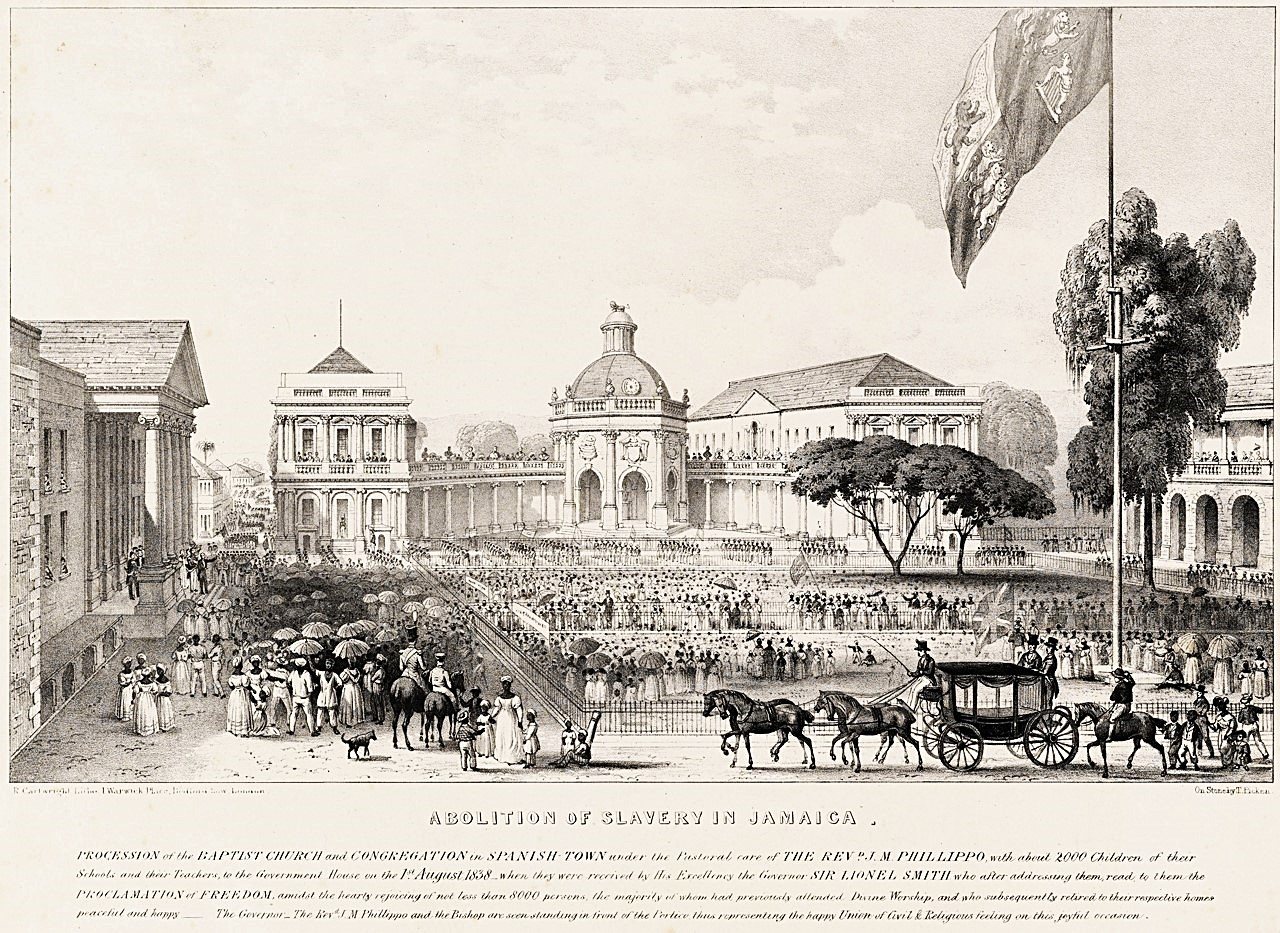
Kaba lived to see slavery end in Jamaica, sixty-one years after he was taken from Africa. For the celebration of August 1838 he wrote an address in Arabic letters, but in English words spelled out in that script, a way of writing called ajami. It was read at a celebration in Manchester parish and given to the governor, Sir Lionel Smith, who kept it among his own papers.78 It is now in the Public Record Office of Northern Ireland, in Belfast.9 Read again in 2019, it speaks of Africa, of “chainhood” and of the “end of torture”: words of suffering that the official translation of 1838 left out.78
The road home
Abu Bakr wanted to go home. He crossed to England in the care of another magistrate, Captain Oldrey, and set out with the English traveler John Davidson, who meant to reach Timbuktu by way of Morocco. In Morocco they met people who knew his family, who said that one of his relations was then governor of Timbuktu.4 Davidson had crossed half the desert toward Timbuktu when he was murdered. In 1837 the Royal Geographical Society had only reports of Abu Bakr: he was supposed to have gone on toward Timbuktu, the sheikh of Wad Nun had sent for him, and if he escaped the perils of the desert he would probably return to England.5 No open record we have found tells what became of him.
The Mandingos of Trinidad
In 1804 the governor of Trinidad, Sir Thomas Hislop, ordered Fort George built at St James to defend Port of Spain. Among the enslaved men who built it was Jonas Mohammed Bath, a Mandingo. He formed a Mandingo Society to pool money and buy the freedom of enslaved Mandingos, and in petitions to the colonial government he asked that he and his followers be returned to Africa.10 The Mandingos of Trinidad were a close Muslim community from Senegambia who worked and saved to buy their own freedom and that of their brothers, and they never gave up the thought of going home. Bath was their first leader.11
In 1838 twelve men of the Mandingo nation sent a memorial asking to be sent, with their families, to Sierra Leone. It gives both their own names and their slave names, with their signatures in Arabic, and it is kept today in the National Archives at Kew, in London.12 That year the Admiralty wrote that it could not carry one of them, Mahommed Sissei, to Sierra Leone on the ship Parmelia.13
Bahia, 1835
In Salvador, the capital of Bahia in Brazil, enslaved and freed Africans rose on the night of 24 to 25 January 1835, at the end of the month of Ramadan.14 They were led by Yoruba Muslims, known as malês, from Ìmàle, a word for Muslim in Yoruba.15 Hausa Muslims fought beside them.14 The court of Bahia, in its own account of the revolt, writes that the rebels were dressed in white and carried amulets with phrases of the Quran in Arabic.16
An informer gave them away on the afternoon of the 24th, and the fighting began in the night.16 The rebels attacked the City Hall, whose basement prison held one of the most respected Malê leaders, the aged Pacífico Licutan, whose Muslim name was Bilal. He was there not for rebellion but as property, held to pay his master’s debts. The fighting left the city in turmoil for several hours.15 Seventy-nine people died, seventy of them rebels.16 João José Reis, the historian of the revolt, puts the rebels at close to six hundred; the court’s account says about fifteen hundred.1516 It has been called the largest urban slave revolt in the Americas.16
In the rebels’ houses the police found small books, papers in Arabic, writing boards, leather pouches worn as amulets, and prayer beads without a cross. The chief of police wrote that the papers were in unknown characters that resembled Arabic, and a Hausa slave named Albino was brought to translate nine of them.16 The state archive of Bahia still holds the papers; nearly all of them, its director says, are passages of the Quran written as prayers and words of protection.14
The punishment was heavy. Two hundred and eighty-nine people stood trial, and the archive keeps the case files of 234 of them, fourteen of them women. Four men were condemned to hang, among them Luís Sanin, the main teacher of the Quran schools; no hangman could be found, and they were shot. Licutan, who had been in prison throughout, was sentenced instead to a thousand lashes. A provincial law of May 1835 ordered freed Africans out of Bahia, and a first list banished 154 to Africa.16
Pernambuco and Rio
Mahommah Gardo Baquaqua, whose own account is in this reading room, came ashore at Pernambuco after the crossing. He was sold to a baker and sent out to sell bread, tried to drown himself rather than live as a slave, was shipped to Rio de Janeiro, and was sold to the captain of a ship, on which he reached New York and his freedom.17 His story is told in chapter VI, and in his own words here.
An imam from Baghdad
In 1865 or 1866 a storm in the Atlantic brought an imam of the Ottoman navy, Abd al-Rahman al-Baghdadi, to Brazil.1819 There he came to know enslaved and free Afro-Brazilian Muslims and tried to teach them Islam as he understood it.19 His account of all he saw in Brazil survives, it seems, in a single manuscript.18
Go and see
In Salvador, the Museu Afro-Brasileiro of the Federal University of Bahia, on the Terreiro de Jesus in the old Faculty of Medicine, holds more than 1,100 pieces of African and Afro-Brazilian material culture; it is not a memorial to the revolt.20 The revolt’s papers, the Arabic writings among them, have been digitized by the state archive of Bahia and can be read online.14 The British government’s travel advice for Brazil, as updated on October 7, 2026, warns against travel only to river areas in the west of Amazonas State, far from Salvador, and asks visitors to avoid all favelas, including tours.24
In Spanish Town, the capital of Jamaica until 1872, the proclamation of the abolition of slavery was read from the steps of King’s House in 1838.21 The Jamaica Archives there keep the deeds that released people from apprenticeship after 1834.22 The British advice for Jamaica notes that Hurricane Melissa struck the island in October 2025, and that all the western parishes suffered significant damage.25
In Trinidad, Fort George stands at St James, outside Port of Spain.10 The National Archives of Trinidad and Tobago, at the corner of New and St. Vincent Streets in Port of Spain, charge nothing to visit; in October 2026 its search room kept reduced hours.23 The British advice for Trinidad and Tobago warns of a high level of violent crime.26
Sources
- Gonzalo Fernández de Oviedo, Historia general y natural de las Indias, tomo 1 (Madrid, 1851), libro IV, capítulo IV. archive.org
- Recopilación de leyes de los reynos de las Indias (Madrid, 1681), libro IX, título XXVI, leyes 17 and 19, and libro VII, título V, ley 29. archive.org
- R. R. Madden, A Twelvemonth’s Residence in the West Indies, during the Transition from Slavery to Apprenticeship, volume 2 (London, 1835), letters XXX to XXXII. archive.org
- G. C. Renouard, “Routes in North Africa, by Abu Bekr es Siddik,” Journal of the Royal Geographical Society of London 6 (1836), pages 100 to 113. archive.org
- G. C. Renouard, “Notice of the late Mr. Davidson,” and “Progress of Geography in 1836-7,” Journal of the Royal Geographical Society of London 7 (1837), pages 145 and 184 to 185. archive.org
- Paul E. Lovejoy, “Comparing the Life Histories of Two Muslims in the Americas: Muhammad Kaba Saghanughu and Mahommah Gardo Baquaqua,” Estudios de Asia y África (El Colegio de México), catalog record with abstract. revistas.colmex.mx
- Elizabeth A. Dolan and Ahmed Idrissi Alami, “Muhammad Kaba Saghanughu’s Arabic Address on the Occasion of Emancipation in Jamaica,” William and Mary Quarterly 76, no. 2 (April 2019), pages 289 to 312, abstract. oieahc.wm.edu
- Elizabeth A. Dolan and Ahmed Idrissi Alami, “Origins of a Collaboration,” Omohundro Institute of Early American History and Culture, May 31, 2019. oieahc.wm.edu
- Princeton University, American Contact: Textual Objects, “Muhammad Kaba Saghanughu’s Arabic Address” (2020). americancontact.princeton.edu
- National Archives of Trinidad and Tobago, Our African Heritage: Stories of Resistance and Resilience in Familiar Places, “Fort George: Jonas Bath, Mandingo.” natt.gov.tt
- Maya Doyle, “Freed Africans Post Emancipation,” National Trust of Trinidad and Tobago, August 1, 2020. nationaltrust.tt
- The National Archives (United Kingdom), CO 295/124, Trinidad original correspondence, 1838: the memorial of twelve Africans of the Mandingo nation. beta.nationalarchives.gov.uk
- The National Archives (United Kingdom), CO 295/123, Trinidad original correspondence, 1838: letters from the Admiralty. beta.nationalarchives.gov.uk
- Government of Bahia, “Arquivo Público da Bahia preserva documentos da Revolta dos Malês,” February 2025. ba.gov.br
- João José Reis, “The Malê Revolt,” translated by Molly Quinn, pages 183 to 186, as assigned by the University of Warwick, Department of History. warwick.ac.uk
- Lidivaldo Reaiche Raimundo Britto, “O Tribunal da Relação da Bahia e a Revolta dos Malês,” Tribunal de Justiça do Estado da Bahia, May 22, 2023. tjba.jus.br
- Mahommah G. Baquaqua and Samuel Moore, Biography of Mahommah G. Baquaqua, a Native of Zoogoo, in the Interior of Africa (Detroit, 1854), on Documenting the American South, University of North Carolina. docsouth.unc.edu
- István Ormos, “Survival of an Old Literary Genre: al-Baghdadi’s Account of His Journey to Brazil,” The Arabist: Budapest Studies in Arabic 15 and 16 (1995), pages 187 to 193, abstract. arabist.hu
- Ottoman History Podcast, “An Ottoman Imam in Brazil,” with Ali Kulez, April 2024. ottomanhistorypodcast.com
- Museu Afro-Brasileiro (MAFRO), Universidade Federal da Bahia. mafro.ceao.ufba.br
- Jamaica National Heritage Trust, Spanish Town. jnht.com
- National Library of Jamaica, Caribbean Database of Documentary Heritage: Jamaica (manumission deeds, Jamaica Archives). nlj.gov.jm
- National Archives of Trinidad and Tobago, Visiting Us. h.natt.gov.tt
- Foreign, Commonwealth and Development Office (United Kingdom), Brazil travel advice, updated October 7, 2026. gov.uk
- Foreign, Commonwealth and Development Office (United Kingdom), Jamaica travel advice, updated October 7, 2026. gov.uk
- Foreign, Commonwealth and Development Office (United Kingdom), Trinidad and Tobago travel advice, updated October 7, 2026. gov.uk
Teaching this chapter? Print the study pack: a leader’s page, a handout with readings and questions, and the answers.