The Monsoon Coast
On the east coast of Africa, Islam came by sea. Towns of coral stone grew up along the shore, traded across the Indian Ocean, and built mosques that still stand.
The shores
Swahili, the language of the East African coast, takes its name from an Arabic word for shores. In 1872 the explorer Richard Burton noted that El Sawahil, the shores, was still the name of 600 miles of that coast.1 When Ibn Battuta sailed south from Mogadishu about 1331, he wrote that he was bound for the Sawahil country, to visit the town of Kilwa.2
The towns of this coast faced the Indian Ocean and lived by trade across it. At Kilwa, gold and ivory from the interior were traded for silver, carnelians, perfumes, Persian faience and Chinese porcelain.3 This chapter follows Islam along that shore, from the first mosques to the nineteenth century, and to a school in Lamu.
The first mosques
In the 1980s the archaeologist Mark Horton excavated Shanga, a town on the coast of Kenya that was abandoned in 1425. At its center he found a sequence of mosques, each rebuilt over the last, nine times between 780 and 1000. The first, from 780 to 920, were small buildings of wattle and daub, with mud walls on close-set posts; a small mihrab, the niche that marks the direction of prayer, appears by 850. It is evidence of Islam practiced on this coast as early as 780, about a century after the death of the Prophet.4
Horton also found that the stone town had been preceded by an African town with the very same layout.5 He has argued that Islam began there with a small group of Muslims, perhaps from abroad, and spread slowly to the wider population.4
On Zanzibar, at Kizimkazi, a mosque bears Kufic inscriptions about its building on a Sunday in the month of Dhu al-Qa’dah in the year 500 after the Hijrah, which is 1107. The scholar who published them in 1922 called them all the more valuable because they bear an exact date.6
An island bought with cloth
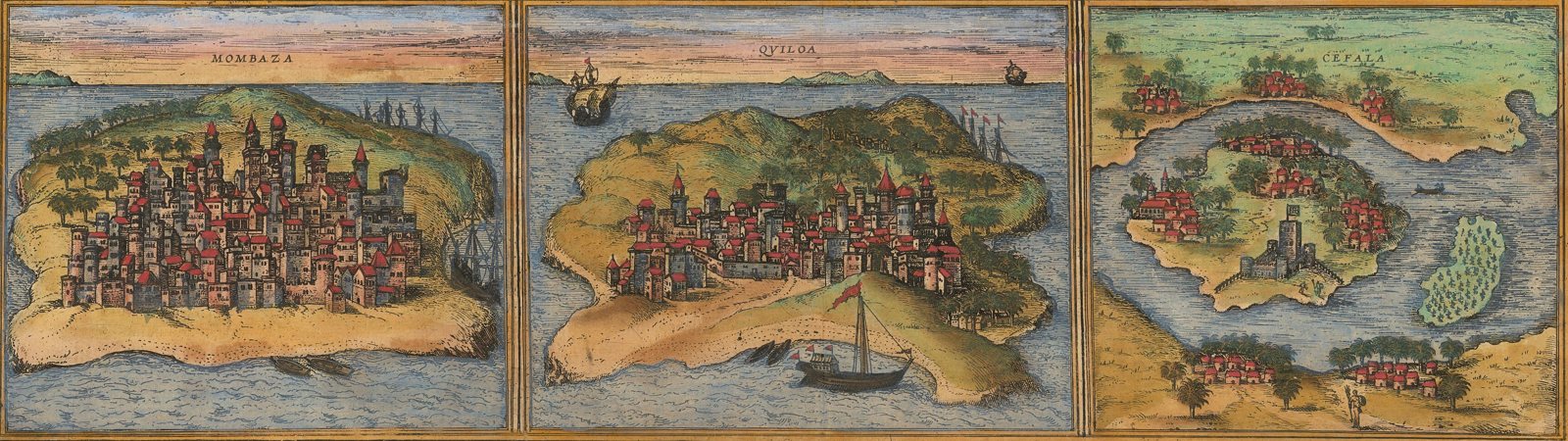
Kilwa, an island off the coast of today’s Tanzania, kept a chronicle of its rulers. In the version Arthur Strong summarized in 1895, a Sultan of Shiraz in Persia named Hasan son of Ali saw in a vision a rat with an iron snout gnawing at the walls, and took it as a sign that his country would fall. He sailed away with his six sons in seven ships, and the sixth ship came to Kilwa.7
The newcomers found a Muslim already living on the island with his family, and a mosque. Through him they offered to buy Kilwa from the chief of the neighboring land, who named his price: enough colored cloth to surround the whole island. The cloth was laid, and the chief took it and surrendered the island.7 It is a founding story. People had lived on Kilwa long before: it grew from earthen buildings of the eighth century into a city of stone by the fifteenth.5
Kilwa at its height
Kilwa was lived in from the ninth century to the nineteenth, and it was richest in the thirteenth and fourteenth. Its Great Mosque, built in the eleventh century and greatly enlarged in the thirteenth, is roofed entirely with domes and vaults, some of them set with Chinese porcelain, and it is the oldest standing mosque on the East African coast. Between about 1310 and 1333 the palace of Husuni Kubwa was built, with a large octagonal bathing pool.3
Kilwa’s wealth was gold. Duarte Barbosa, a Portuguese writer whose book was completed about 1518, recorded that before the Portuguese came, the Muslims of Sofala and the coast to the south were all subject to the King of Kilwa, “the most mighty king among them,” and that no ship passed toward Sofala without first coming to the island.8
Kilwa also minted its own coins, from the eleventh century to the fourteenth.3 During the Second World War, Morry Isenberg, an Australian airman, found five of them on a beach on Marchinbar Island, off northern Australia, with four Dutch coins dated between 1690 and 1784. The museum in Sydney that holds them calls them the oldest coins yet found in an Australian context.9 Kilwa coins had been found outside Tanzania only twice before, once in Zimbabwe and once in Oman.10
A sultan of gifts
In 1331 or 1332, Ibn Battuta stopped at Kilwa.3 He came by way of Mombasa, a large island whose people, he wrote, were pious, honorable and upright, with well-built wooden mosques.2 Of Kilwa he wrote:
Kulwa is a very fine and substantially built town, and all its buildings are of wood. Its inhabitants are constantly engaged in military expeditions, for their country is contiguous to the heathen Zanj. The sultan at the time of my visit was Abu'l-Muzaffar Hasan, who was noted for his gifts and generosity. He used to devote the fifth part of the booty made on his expeditions to pious and charitable purposes, as is prescribed in the Koran, and I have seen him give the clothes off his back to a mendicant who asked him for them.
The fuller French translation of 1854 adds that the sultan was also called Abu al-Mawahib, the father of gifts, for the number of his gifts, and that the gifts had a source: he raided the land of the Zanj, who were not Muslims, carried off booty, and spent a fifth of it as the Quran prescribes.11
The Portuguese
In April 1498 Vasco da Gama’s ships came up this coast on their way to India. On April 7 they anchored off Mombasa but did not enter the port. On April 14 they anchored off Malindi, thirty leagues farther on. The king of Malindi gave them a pilot, a native of Gujarat in India according to the Portuguese chroniclers, and on April 24 they sailed for Calicut.12
In 1505 the Portuguese came back. A fleet under Francisco de Almeida took Kilwa by force, Barbosa wrote, because its king refused to obey the King of Portugal, and built a fort there. At Mombasa, he wrote, the Portuguese “slew many of his people and also took captive many, both men and women, in such sort that it was left ruined and plundered and burnt.”8 With the Portuguese fort on Kilwa, the island’s decline began.3
At the end of the sixteenth century the Portuguese built Fort Jesus at Mombasa, on a spur of coral rock, and held it for a century. UNESCO, which listed it in 2011, calls it a witness to exchanges among peoples of African, Arab, Turkish, Persian and European origin.13
Zanzibar and the trade in people
In 1840 Seyyid Said, whose capital had been Muscat, moved his court to Zanzibar. He owned estates and clove plantations, and by the account of a British writer in 1905 he was “the greatest slave-trader in the world,” drawing the greater part of his revenue from the sale of slaves: from 10,000 to 15,000 were sold each year from his African dominions, and as many more brought into Zanzibar.14
Zanzibar became one of the main slave-trading ports of East Africa.15 On June 5, 1873, his son, Sultan Barghash bin Said, signed a treaty with Britain. The export of slaves from the mainland coast was to “entirely cease,” and all public markets in his dominions for the buying and selling of imported slaves were to be “entirely closed.”16 Christ Church, Zanzibar’s Anglican cathedral, was built on the site of the last slave market.15
Lamu
Swahili was written in Arabic script. Manuscripts of Swahili poetry in that script became a marker of coastal identity, and the oldest Swahili writings yet found are letters dated 1724, kept in Goa.19
In 1889 Habib Swaleh, a scholar of Hadrami descent who had come to Lamu from his birthplace in the Comoro Islands, founded the Riyadha Mosque, and it soon became a center of learning.17 It is one of the longest continuously functioning Islamic teaching institutions in the Swahili world, and some of its manuscripts carry Swahili translations written between the lines in Arabic script.18
At the beginning of the twentieth century Habib Swaleh gave the Lamu Maulid, the celebration of the Prophet’s birthday, its present form. In 2012 the Riyadha still organized it, in the care of his descendants.17
Go and see
The ruins of Kilwa Kisiwani and Songo Mnara have been on the World Heritage List since 1981, and from 2004 to 2014 they were on its list of sites in danger.3 Kilwa Kisiwani can be reached only by boat from Kilwa Masoko on the mainland: about twenty minutes by engine boat, longer by dhow. Allow at least two hours, better half a day or a full day. Songo Mnara lies 12 km farther south, at least an hour by boat.20
Fort Jesus in Mombasa has been on the list since 2011, and the Stone Town of Zanzibar, with Christ Church on the site of the market, since 2000.1315
Before going to Lamu, read the British government’s travel advice. As updated on October 16, 2026, it advises against all travel to Lamu County except Lamu Island and Manda Island, and asks visitors to fly to Lamu Airport rather than travel by road.21 In Tanzania, the only area of the southern coast it warns against is within 20 km of the border with Mozambique’s Cabo Delgado province.22
Sources
- Richard F. Burton, Zanzibar; City, Island, and Coast, volume 1 (London, 1872), page 129. archive.org
- Ibn Battuta: Travels in Asia and Africa, 1325-1354, translated and selected by H. A. R. Gibb (London: Routledge, 1929). archive.org
- UNESCO World Heritage Centre, Ruins of Kilwa Kisiwani and Ruins of Songo Mnara. whc.unesco.org
- Stephanie Wynne-Jones and Jeffrey Fleisher, “The Eastern African Coast,” in The Oxford Handbook of Islamic Archaeology (Oxford University Press, 2021), pages 377 to 394. eprints.whiterose.ac.uk
- Samir S. Patel, “Stone Towns of the Swahili Coast,” Archaeology, January and February 2014. archaeology.org
- S. Flury, “The Kufic Inscriptions of Kisimkazi Mosque, Zanzibar, 500 H. (A.D. 1107),” Journal of the Royal Asiatic Society (1922). archive.org
- S. Arthur Strong, “The History of Kilwa, Edited from an Arabic MS.,” Journal of the Royal Asiatic Society (1895), beginning on page 385. archive.org
- The Book of Duarte Barbosa, completed about 1518, translated by Mansel Longworth Dames, volume 1 (Hakluyt Society, 1918). archive.org
- Powerhouse Museum, Sydney, Collection of coins, photograph and documentation: the coins found on Marchinbar Island, Northern Territory. collection.powerhouse.com.au
- Mike Owen, “Trade Winds,” Australian Geographic (2014), on the Kilwa coins found in Arnhem Land. pastmasters.org.au
- C. Defrémery and B. R. Sanguinetti, Voyages d’Ibn Batoutah, volume 2 (Paris, 1854), page 193. archive.org
- A Journal of the First Voyage of Vasco da Gama, 1497-1499, translated and edited by E. G. Ravenstein (Hakluyt Society, 1898). archive.org
- UNESCO World Heritage Centre, Fort Jesus, Mombasa. whc.unesco.org
- Robert Nunez Lyne, Zanzibar in Contemporary Times (London, 1905), pages 39 and 53. archive.org
- UNESCO World Heritage Centre, Stone Town of Zanzibar. whc.unesco.org
- Treaty between Great Britain and the Sultan of Zanzibar for the suppression of the slave trade, June 5, 1873, printed in Papers Relating to the Foreign Relations of the United States, 1873, document 196. history.state.gov
- Iain Walker, “Understanding a diaspora through Lamu Maulid,” Centre on Migration, Policy and Society, University of Oxford, March 6, 2012. compas.ox.ac.uk
- Anne K. Bang, “The Manuscript Collection of the Riyadha Mosque, Lamu, Kenya,” Tombouctou Manuscripts Project, University of Cape Town, June 15, 2011. tombouctoumanuscripts.uct.ac.za
- Clarissa Vierke, “Writing Songs, Singing Texts: Orality and Literacy in Swahili Manuscripts,” Manuscript Cultures 17 (University of Hamburg, 2021). csmc.uni-hamburg.de
- Tanzania Tourist Board, Kilwa. tanzaniatourism.com
- Foreign, Commonwealth and Development Office (United Kingdom), Kenya travel advice, updated October 16, 2026. gov.uk
- Foreign, Commonwealth and Development Office (United Kingdom), Tanzania travel advice, updated October 20, 2026. gov.uk
Teaching this chapter? Print the study pack: a leader’s page, a handout with readings and questions, and the answers.