Along the Nile
The envoy who came to Aksum to fetch the refugees went back years later, and the king who had sheltered them sent him to the Prophet. Before long he led an army into Egypt. Up the Nile, Christian Nubia held the Muslims off and made a treaty that lasted for centuries.
The envoy goes back
When Quraysh sent envoys to Aksum to bring the first refugees home, one of them was Amr ibn al-As. The Negus heard the refugees, returned the gifts and sent the envoys away. Years later Amr went back.
Ibn Ishaq has the story from Amr himself. After the Battle of the Trench, Amr took a few men of Quraysh to the Negus with a large gift of leather, meaning to wait under his protection to see who won. While they were there, the Prophet’s own messenger, Amr ibn Umayya al-Damri, came to the king on the business of Ja’far and his companions. Amr asked the Negus to hand the man over so that he could kill him.1
The king struck him in the face. Would Amr have him give up the messenger of a man to whom the great Namus came, as it used to come to Moses? He told Amr to follow Muhammad, who was right and would triumph over his enemies as Moses had triumphed over Pharaoh and his armies. Amr gave his allegiance to Islam there, at the king’s hand. Then he set out for Madinah, met Khalid ibn al-Walid on the road bound on the same errand, and the two gave their allegiance to the Prophet a little before the opening of Makkah.1
So the man who would lead the Muslims into Pharaoh’s country had been sent to the Prophet by the Christian king of Aksum.
Kinship with Egypt
Egypt was already in the story. Among the letters the Prophet sent to the rulers around Arabia, Ibn Ishaq lists one carried by Hatib ibn Abi Balta’a to the Muqawqis, whom he calls the king of Alexandria. Ibn Hisham, who edited Ibn Ishaq’s book, adds that the Muqawqis sent the Prophet a woman named Mariya the Copt, from Hafn in the province of Ansina, and that she became the mother of his son Ibrahim.1
Abu Dharr reported what the Prophet said about Egypt:2
You would soon conquer Egypt and that is a land which is known (as the land of al-qirat). So when you conquer it, treat its inhabitants well. For there lies upon you the responsibility because of blood-tie or relationship of marriage (with them).
Ibn Hisham records how an early teacher explained the words. The blood tie is Hagar, the mother of Ishmael and of the Arabs, who came from Egypt. The tie of marriage is Mariya.1 Al-Baladhuri, the historian of the conquests, gives a version in which the Prophet asks that the Copts in particular be treated well, and he adds that the poll tax on Mariya’s home village was later canceled at the request of the Prophet’s grandson al-Husain, or of al-Husain’s son.3
Ibrahim did not live long. Anas ibn Malik was there when the child was dying in the house of his wet nurse’s husband, and saw the Prophet weep. Asked about his tears, the Prophet called them mercy, and said:4
The eyes are shedding tears and the heart is grieved, and we will not say except what pleases our Lord, O Ibrahim ! Indeed we are grieved by your separation.
The surrender of Alexandria
Al-Baladhuri says that Amr, with al-Zubayr ibn al-Awwam beside him, subdued Egypt in the twentieth year after the Hijrah, about 640. The people agreed to pay a tax of two dinars on every man, but not on women or boys. When al-Zubayr asked Amr to divide the land among the soldiers, Amr wrote to the caliph Umar, who told him to leave it as it was, so that the descendants of the descendants might profit by it. The next year Amr marched on Alexandria.3
The other side of the story was written by an Egyptian. John, Coptic bishop of Nikiu, was probably born about the time of the conquest and was a leading bishop by 690. His chronicle reached us through an Ethiopic translation, and its English translator quoted the historian Alfred Butler: without it, a history of the conquest could not have been written.5
John tells how Cyrus, the patriarch whom the empire had set over Alexandria, came to Amr to buy peace with tribute. The terms were that the Roman troops would sail away and no Roman army would return; that the Muslims would take hostages and keep the peace, stop seizing churches and not meddle in the affairs of the Christians; and that the Jews could stay in Alexandria. When the garrison sailed for Cyprus, Amr entered the city without a fight, and its people, worn out by their troubles, received him with respect.56
John does not flatter him. He complains bitterly of the taxes, which Amr raised and his officials raised further, and at one point he says Amr had no mercy on the Egyptians. Yet he also records that Amr took none of the property of the churches, committed no act of spoliation or plunder, and preserved them all his days. And he reports what people said: that the Romans had lost Egypt because the emperor Heraclius had persecuted the Egyptians’ own church.5
The patriarch comes home
The head of that church, the Coptic patriarch Benjamin, had been in hiding from the Byzantine authorities for years, moving from one fortified church to another. The Coptic church’s own History of the Patriarchs preserves the letter Amr sent through the provinces of Egypt once Alexandria was his:6
There is protection and security for the place where Benjamin, the patriarch of the Coptic Christians is, and peace from God; therefore let him come forth secure and tranquil, and administer the affairs of his Church, and the government of his nation.
Benjamin came home to Alexandria after thirteen years away, as both the History and John of Nikiu record. Amr received him with honor, the History says, and told his companions that in all the lands they had taken he had never seen a man of God like him. Benjamin led the Copts until 661.65
The first mosque
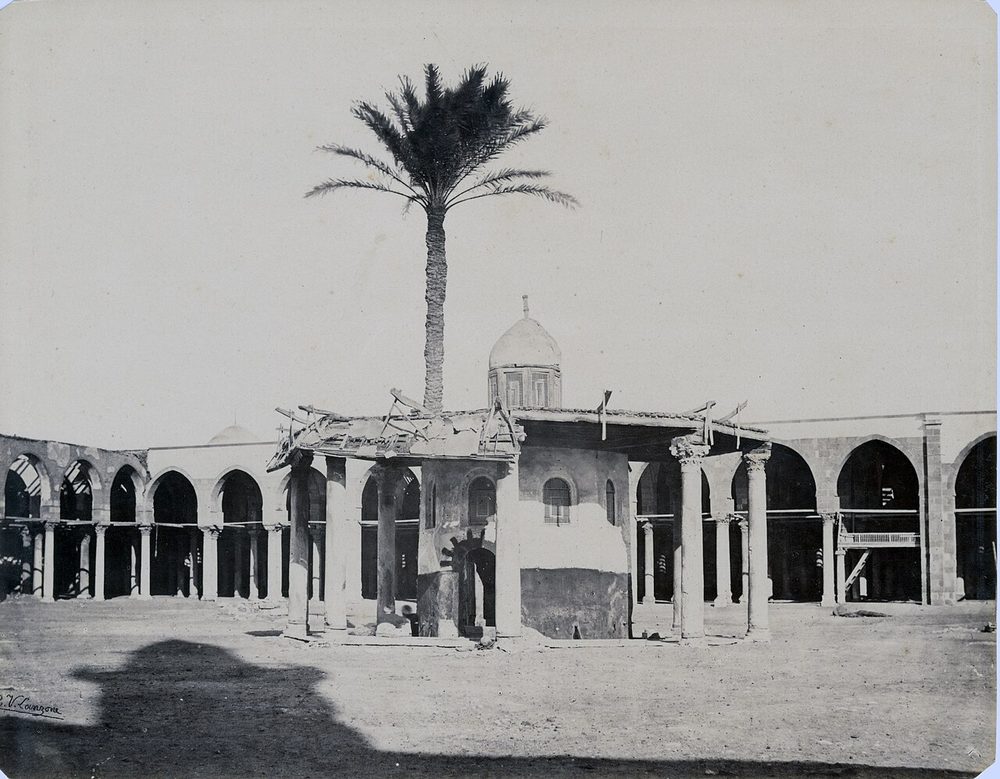
Beside the Byzantine fortress of Babylon, Amr laid out a new capital, Fustat, which now lies inside Cairo.67 About a year after the conquest, by order of the caliph Umar, he founded its mosque, the first building of the new city. Companions of the Prophet helped to raise it, among them al-Zubayr ibn al-Awwam and Ubada ibn al-Samit. It began as a shed with columns of palm trunks.7
Egypt’s Ministry of Tourism and Antiquities calls the Mosque of Amr ibn al-As the oldest surviving mosque in Egypt and in Africa. It has been rebuilt so often that very little of the original is left, and what stands in Old Cairo today is a twentieth-century reconstruction. People still pray in it.7 In 972, in the new city of Cairo, al-Azhar held its first Friday prayer. That story is in the next chapter.
The archers of the eyes
Up the Nile from Egypt lay Nubia, and in it the Christian kingdom of Makuria, whose capital was Dongola.89
Once Egypt was taken, Amr sent horsemen south under Uqba ibn Nafi, who would later found Kairouan. In Nubia they met archers so accurate that the Muslims called them the archers of the eyes. A man who fought there remembered a single day on which a hundred and fifty eyes were put out. Amr would not make peace with them.3
His successor as governor, Abdallah ibn Sa’d ibn Abi Sarh, laid siege to Dongola in 652 and badly damaged its cathedral. Then the two sides made peace. The treaty, called the baqt, was kept by both sides, by the count of the Polish archaeologist Włodzimierz Godlewski, for 520 years.83
Al-Baladhuri gives its terms. The Nubians paid no tax. Each year they sent a present of slaves, three hundred in one report and four hundred in another, and received food of the same value in return. A later caliph, al-Mahdi, fixed it at 360 slaves and a giraffe, against wheat, vinegar, wine, clothes and mattresses. When the Nubians told him that they took the slaves from their enemies and, when they could not find enough, had to give their own children, he allowed one year’s payment to count for three.3 The treaty kept the peace, and it was paid for in people.
The throne hall
Makuria stayed Christian for centuries. Early in the ninth century its kings raised a throne hall at Dongola, a two-story building on a sandstone outcrop, twelve meters high.9
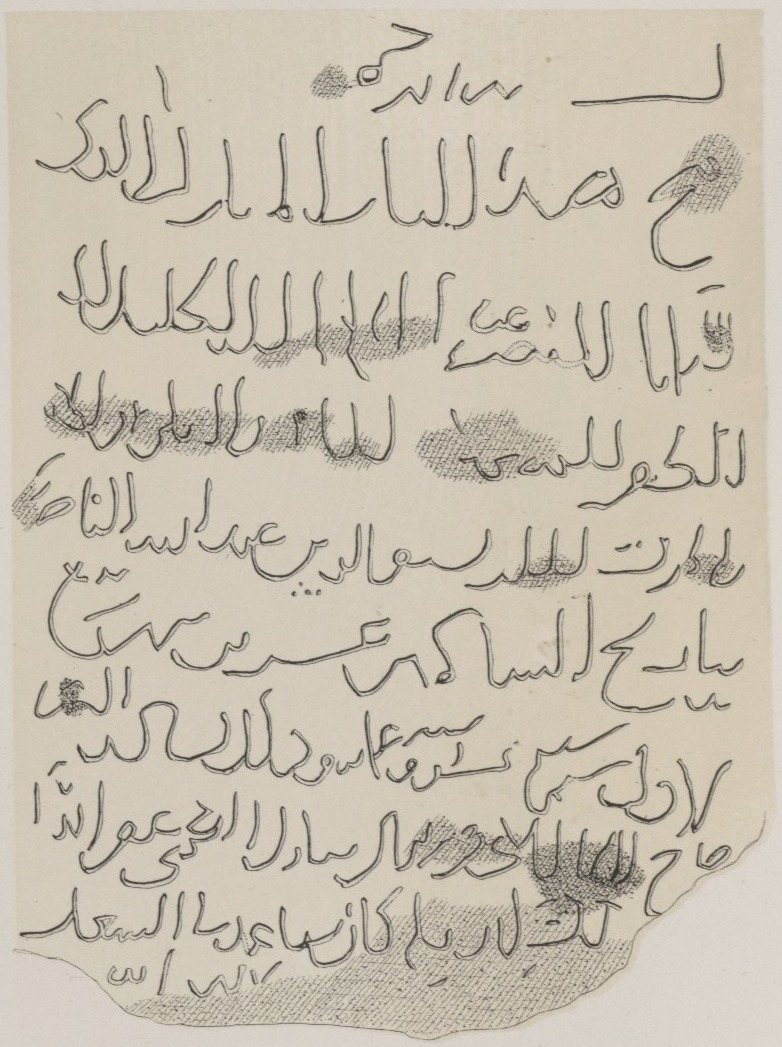
On May 29, 1317, an inscription in Arabic was set into its wall to mark its conversion into a mosque.10 It served as one for more than six hundred years, until 1967, and it is the oldest preserved mosque in Sudan. From the sixteenth century, under the Funj Sultanate, Dongola became a center for the teaching of Islam.9
One of its sons, Satti Majid, born there in 1883, would take a question about faith from America to the scholars of al-Azhar. His story is in After the Water.
Go and see
The Mosque of Amr ibn al-As stands in Old Cairo and still holds prayers.7 At Old Dongola, the University of Warsaw began work in 2023, with Sudan’s National Corporation for Antiquities and Museums, to stabilize the old mosque and open it to visitors.9 Sudan is at war, and the British government advises against all travel there. For now, Dongola is best seen through its archaeologists’ work.11
Sources
- Ibn Ishaq, The Life of Muhammad, translated by A. Guillaume (Oxford University Press, 1955), pages 484 and 485 and 789, with Ibn Hisham’s notes on pages 691 and 710.
- Sahih Muslim 2543b, narrated by Abu Dharr. sunnah.com
- Al-Baladhuri, The Origins of the Islamic State, translated by Philip Khuri Hitti, volume 1 (Columbia University, 1916), pages 335 to 382, on Egypt and Nubia. archive.org
- Sahih al-Bukhari 1303, narrated by Anas ibn Malik. sunnah.com
- John, Bishop of Nikiu, The Chronicle of John, Bishop of Nikiu, translated from the Ethiopic by R. H. Charles (1916), chapters 120 and 121, with the translator’s introduction. tertullian.org
- History of the Patriarchs of the Coptic Church of Alexandria, part 2, translated by B. Evetts, Patrologia Orientalis 1 (1904), on Benjamin I. tertullian.org
- Ministry of Tourism and Antiquities, Egypt, The Mosque of ‘Amr ibn al-‘As. egymonuments.gov.eg
- Włodzimierz Godlewski, “Dongola, Capital of Early Makuria: Citadel, Rock Tombs, First Churches,” in a 2014 volume in honor of Steffen Wenig (Sudanarchäologische Gesellschaft zu Berlin). sag-online.de
- University of Warsaw, “Renovation of the oldest mosque in Sudan,” February 27, 2023. en.uw.edu.pl
- University of Warsaw, Database of Medieval Nubian Texts, no. 611: the stela marking the conversion of the throne hall at Dongola to a mosque, dated May 29, 1317. dbmnt.pcma.uw.edu.pl
- United Kingdom Foreign, Commonwealth and Development Office, Sudan travel advice. gov.uk
Teaching this chapter? Print the study pack: a leader’s page, a handout with readings and questions, and the answers.